
September 1986. I was a Year 10 student at a regional high school in New South Wales, and I was about to get my first taste of the computer industry.
My work experience placement was at a local computer shop called RAMROD — and from the moment I walked in, I knew this was exactly where I was supposed to be.
The store manager, Greg, was the kind of guy who made everything feel possible. He drove a battered 1969 VW Beetle with a personalised plate that read “PORSCHE” — which told you everything you needed to know about his sense of humour and his personality. The shop hummed with the energy of an industry on the verge of explosion. Home computers weren’t a novelty anymore. They were the future. And I was standing right in the middle of it.
Two Weeks That Would Echo for Years
For two weeks, I threw myself into everything RAMROD had to offer. I sold computers. I watched how a real technology business operated. I soaked up every scrap of knowledge I could find.
But the project that consumed me — the one I couldn’t put down — was building an Adventure Game interpreter with a multi-word parser on one of the shop’s hulking KAYPRO luggables.
This was genuinely cutting-edge stuff for a sixteen-year-old in 1986. Text adventures were the gaming genre of the era, and the difference between a simple one-word parser and a proper multi-word parser was the difference between a toy and something that felt real — something that could understand “pick up the rusty key” rather than just “get key.” I was obsessed with getting it right.
What I didn’t know then was that this code — written on a portable computer the size and weight of a sewing machine in a computer shop in regional NSW — would follow me into my professional life.
Four Years Later: The Industry Comes Calling
By 1990, I was working for Patronics — one of Australia’s largest software distributors right at the peak of the home computer boom. The industry had grown from a hobby into a genuine commercial powerhouse, and I was inside it, watching it happen in real time.
And then the KAYPRO parser came back.
My colleague Neil Miller and I had been circling the same idea independently: what if we built a proper graphic and text adventure series? Not a hobbyist project — a real, commercial, marketable game. We had the industry connections. We had the platform. And thanks to four years of festering in the back of my mind, I had the parser.
We chose the Atari 1040 ST as our development machine — a genuinely powerful, beautiful piece of hardware — and we chose STOS as our development language. STOS was a remarkable tool: a BASIC-derived language purpose-built for game development on the ST, capable of smooth sprite animation and fast graphical effects that would have been unthinkable on the machines I’d grown up with.
And so, the Rian Rookaby Quest Adventure series was born.
So the Rian Rookaby “Quest Adventure” series was born.
Evenings, Weekends, and a Dream
We both had full-time jobs at Patronics. That didn’t stop us.
Every evening. Every weekend. We took my original 1986 KAYPRO source code and painstakingly converted it into STOS — ripping out the errors, rebuilding the engine, expanding what had once been a school project into something with genuine commercial ambition. The multi-word parser that had captivated me as a sixteen-year-old was now at the heart of a proper adventure game engine, powering a richly imagined world built around a character named Rian Rookaby.
A few months into development, we made our move. We pitched the series to our contacts at Atari Australia, proposing a joint release through Patronics. The feedback was electric — they loved the story, they were impressed by the progress, and the door was left wide open.
We kept building. We kept pushing.
The News That Changed Everything
Then it hit.
Atari Australia was closing down.
No more Atari STs in the Australian market. No distribution pipeline. No platform. The commercial landscape that had made our game viable had simply ceased to exist — not because our game wasn’t good enough, but because the business of an entire computer manufacturer had collapsed around us.
Rian Rookaby and the Quest for the Sun never made it to market.
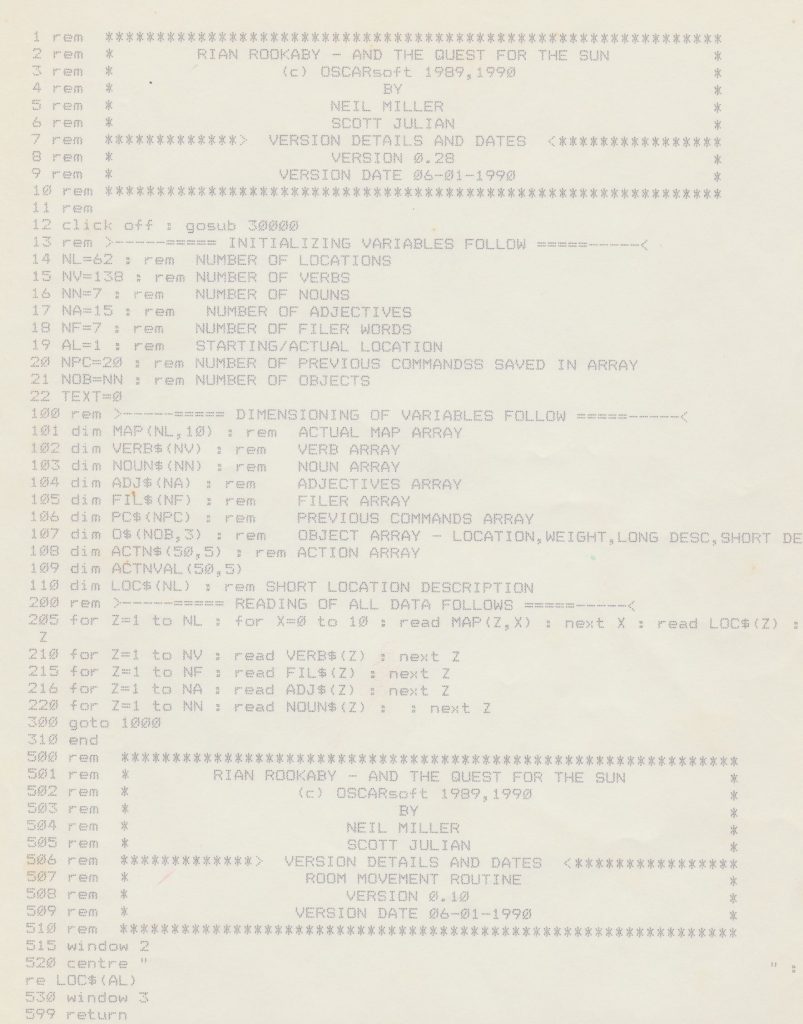
The source code — scanned in 2020 from the original printouts I’d kept for over thirty years — shows those very early beta listings: the parser logic, the world-building scaffolding, the bones of something that genuinely could have been something special. Looking at it now, it’s equal parts pride and bittersweetness. We built something real. The timing just wasn’t on our side.
But here’s the thing about ideas that never quite make it: they don’t disappear. They wait.
And Rian Rookaby has been waiting a long time.